


In this descriptive study, we searched, screened, and evaluated the functionality, inclusiveness, and health education information of menstrual health apps. Five of the six authors were Bachelor of Science in Nursing students who reviewed credible literature on mobile app reviews, menstruation, and menstrual symptom management in preparation for conducting this project. The senior author was a PhD and MBBS-prepared researcher with over 12 years of experience studying menstrual health. The senior author trained and advised the other authors in conducting this project and helped resolve questions or inconsistent ratings between student reviewers.
Figure 1 is the flow chart of app searches and screening.

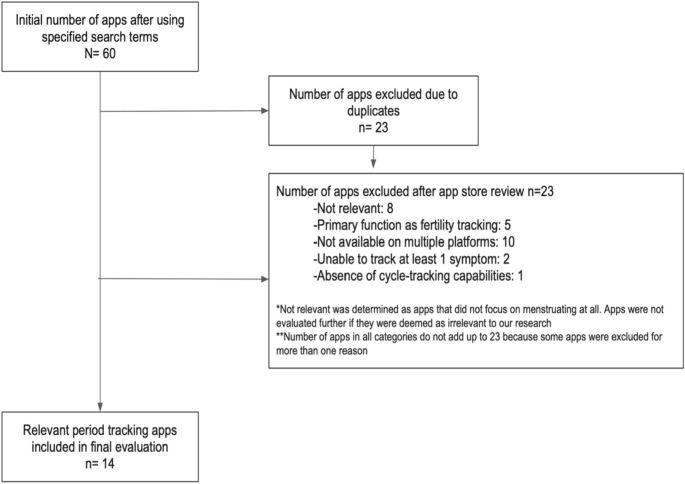
Flowchart for searching and screening of apps
Search strategy
Using an iPhone, authors searched the Apple App Store for menstrual health apps between September 28 th and November 16 th of 2022. The following search terms were used: period pain, period app, and menstrual cramp. We chose these search terms because they are popular terms used by the general public to search for information on menstrual pain and symptoms [20, 21]. Two authors independently searched the Apple App Store using one search term at a time, and any discrepancies in search results were resolved within the group. The first 20 results from each search were listed, resulting in 60 apps to screen for inclusion/exclusion. We listed the first 20 results from each search for two reasons. First, limiting the search allowed the authors to balance the feasibility and comprehensiveness of the review. Second, app store optimization statistics have shown that users only spend an average of 10.2 s on each app store search page before choosing an app to download [22], suggesting that most users download apps ranked highly.
Screening inclusions/exclusion criteria
The list of 60 apps yielded some duplicate results (n = 23). After removing the duplicates, 36 unique apps were screened against the inclusion and exclusion criteria independently by two authors. Apps were included in the review if they were relevant to menstruation, free to download, available in English, able to track at least one menstrual symptom, able to track menstrual cycles, and available on both the Apple Store and Google Play. We cross-searched 36 unique apps on the Google Play Store and included apps available in both the Apple and Google app stores to ensure apps were accessible to users with different devices. Apps were excluded if they met one or more of the following exclusion criteria: the app’s primary function was menopause-tracking or fertility-tracking, the app was designed for men and/or non-menstruating partners, and/or the app was designed for healthcare providers only. Any discrepancies were discussed and resolved between the two authors. When needed, a third author helped reach a final consensus. As shown in Fig. 1, 14 apps met the inclusion criteria.
Data extraction tool and process
Our team developed a standardized data extraction tool based on our evaluation criteria. All authors pilot-tested and revised the extraction tool. For each app, we extracted data on functionality, inclusiveness, and health education information. Two authors independently extracted data from each app between October 2022 and February 2023. Any discrepancies were resolved with discussion within the group.
Functionality
Four aspects of functionality were evaluated, including (1) user experience, (2) internet and language accessibility, (3) privacy, and (4) symptom-tracking ability. To assess user experience (i.e., overall experience a person has when interacting with the app), we examined the presence of promoted or required in-app purchases, third-party advertisements, the overall ease of using the app, the appropriateness of the app’s arrangement (i.e., appropriateness of the size of buttons, icons, and sections), the app’s visual appeal, and the customizability of settings. For accessibility, we evaluated internet requirements and language accessibility. Specifically, we downloaded and opened each app in airplane mode to determine if the internet was required when using the cycle and symptom-tracking functions, and we looked in the app store to see if the apps were available in languages other than English. To assess each app’s privacy features, we reviewed their privacy policies, noting password protection options, the ability to customize privacy settings, the ease of accessing the privacy policy, and details about data sharing. Lastly, symptom-tracking abilities were assessed by counting and recording the number of relevant symptoms listed in each app and the symptom rating scale used (e.g., presence/absence, severity). We noted whether the app provided a visual display of symptom patterns over time. Additionally, we reviewed the app descriptions and references cited in each app and examined specific symptom measurements against the menstrual symptom literature to determine whether they had been validated by research.
Inclusiveness
We assessed inclusiveness by evaluating each app’s ability to account for diverse (1) cycle lengths and regularities, (2) fertility goals, and (3) gender expressions and sexualities. The inclusiveness of cycle lengths and regularities was determined by the app’s ability to enter and tailor cycle lengths other than the typical 28-day cycle. We looked at whether the app had the function present for a user to input their most recent cycle dates. This was evaluated by entering three previous cycle dates based on a typical 28-day cycle. We also noted if apps allowed users to manually enter cycle lengths, as opposed to the app predicting the length for the user. To assess inclusiveness of fertility goals, we examined whether apps offered ovulation prediction and an option to input contraception methods. If an app allowed users to input contraceptive options, the number and types of contraceptive methods were extracted. To assess inclusiveness of gender expression and sexuality, we evaluated the overall neutrality/customizability of the pronouns used in the app and the availability of LGBTQ + content.
Health education information
Three areas of health education information were evaluated including, (1) credibility and comprehensiveness of menstrual health education, (2) presence of additional information on hormonal changes throughout the cycle, and (3) information on when to seek care. First, we looked at the reliability of the menstrual health information, the comprehensiveness of the information, if the information came from a credible source, and at the clarity and accuracy of the charts, graphs, images, and/or videos. Specifically, for comprehensiveness, we assessed whether the menstrual health information covered a wide range of topics, including menstrual cycle phases, symptoms, management strategies, and potential health issues. For credibility, we evaluated whether the information was sourced from reputable organizations or publications and looked for citations and references within the app content to ensure it was evidence-based. We assessed the clarity and accuracy of charts, graphs, images, and videos by checking if visuals accurately reflected the underlying information without distortion or misrepresentation, and whether the data sources were credible and properly cited. We used a scoring system as described in Table 1. Second, we assessed if apps had a presence of additional health information on hormonal changes throughout the menstrual cycle. Lastly, we determined whether the apps provided educational information on when to seek professional care for menstrual symptoms and whether the apps provided a recommended treatment for menstrual symptoms.
Scoring and data analysis
Two authors independently scored each app’s functionality, inclusiveness, and health education information using our adapted version of the Mobile Application Rating Scale [23], a generic tool designed to evaluate mobile apps. Table 1 shows the evaluation criteria upon which each app was scored. From the original Mobile Application Rating Scale, we removed less relevant questions and added questions related to our evaluation criteria. Specifically, we added scoring questions about internet and language accessibility, privacy, menstrual cycle tracking, symptom tracking, inclusiveness, and relevant health education information. With regard to scoring symptom tracking, we decided to count symptoms that changed throughout the menstrual cycle rather than symptoms unrelated to menstruation. These symptoms were not grouped into specific categories (e.g., menstrual symptoms, premenstrual symptoms, menopausal symptoms) because certain symptoms (e.g., sleep problems) can fall under multiple categories. Table 2 shows the symptoms included. High overall scores on the adapted Mobile Application Rating Scale suggest an app is highly functional, aims to be inclusive, and provides quality menstrual health information. The highest possible score was 59 points. Descriptive statistics (mean, standard deviation, frequency, and percentage) were used to summarize the scores.
link