


Data sources
The data involved in the study can be divided into two categories: (i) socioeconomic information such as crop/livestock production, population and sewage discharge were obtained from the following authoritative sources: the National Bureau of Statistics of China, the China Statistical Yearbook8, the China Statistical Yearbook on Environment39, the China City Statistical Yearbook40, the China Rural Statistical Yearbook41, the China Industry Statistical Yearbook42, the China Population & Employment Statistics Yearbook43, the China Fishery Statistical Yearbook44 and the China Forestry and Grassland Yearbook45. In addition, the future population and urbanization rate towards 2060 of SSPs were obtained from Huang et al.46; (ii) coefficients and parameters used for the calculation of N fluxes such as N concentrations in grain and straw or the rate of BNF were mainly taken from the synthesis of peer-reviewed literature and field measurements. The most important coefficients and parameters can be found in Gu et al.15 and Zhang et al.47
Shared socioeconomic pathways (SSPs)
SSPs describe pathways for global socioeconomic development, encompassing factors such as population growth, economic development, energy demand, technological progress, and land use change. SSPs provide a framework for the socioeconomic context of climate change without directly addressing greenhouse gas concentrations or radiative forcing. They outline potential human development trajectories under varying social, economic, and environmental policy scenarios, divided into five distinct pathways: SSP1 (Sustainability), SSP2 (Middle of the Road), SSP3 (Regional Rivalry), SSP4 (Inequality), and SSP5 (Fossil-Fueled Development), representing a range from sustainable development (SSP1) to high-carbon growth (SSP5). This study uses population and urbanization data from three scenarios—SSP1, SSP2, and SSP5—integrated with N management measures of varying intensity (Supplementary Table 9). For example, by 2060, NUE is projected to increase by 40%, 20%, and 0% under SSP1, SSP2, and SSP5, respectively, compared to 2020. Additionally, dietary structure in SSP1 and SSP2 is expected to align with the Chinese Dietary Guidelines by 2030 and 2050, respectively, while SSP5 assumes no dietary change, remaining above dietary guideline standards. More details on these assumptions are provided in Supplementary Table 9. Through these analyses, the study explores the impact of N management on the sustainable development of FEW nexus.
Nitrogen budget
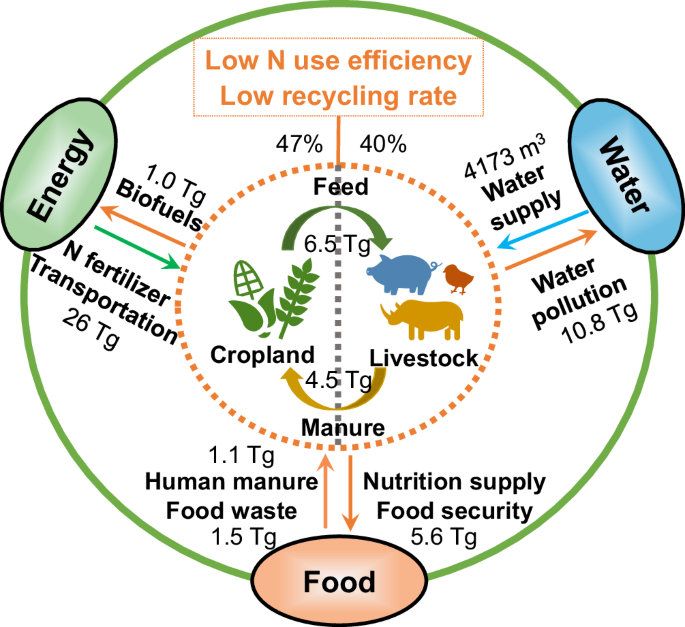
The CHANS model was used in this study to estimate the national N budget. CHANS is a mass balance model with a N focus, consisting of 14 subsystems (Cropland, Forestland, Grassland, Industry, Livestock, Aquaculture, Urban Greenland, Human, Pets, Wastewater treatment plants, Solid waste treatment, Surface water, Groundwater and Atmosphere), which combines N input and output fluxes across the 14 subsystems to provide a comprehensive understanding of the overall N budget in this paper. By firmly restricting interactions between subsystems, the CHANS model can estimate the N fluxes of 14 subsystems and lower the calculation’s uncertainty. The CHANS model was calibrated using data from various authoritative sources such as the National Bureau of Statistics of China and validated by comparing model outputs with observed N fluxes reported in peer-reviewed literature and field measurements from 1980 to 2020. The model parameters were adjusted iteratively to minimize discrepancies between simulated and observed data, ensuring the model accurately reflects N dynamics across the 14 subsystems involved. The principle of the CHANS model is the mass balance of the whole system and each subsystem, shown as Eq. (1):
$${\sum}_{h=1}^{m}{{IN}}_{h}={\sum}_{g=1}^{n}{{OUT}}_{g}+{\sum}_{k=1}^{p}{{ACC}}_{k}$$
(1)
where IN (Tg) and OUT (Tg) represent the total N input (e.g., fertilizer, feed, wastewater) and N output (e.g., grain yields, runoff, NH3 and N2O) respectively, and ACC (Tg) represents N accumulation that is calculated as the difference of inputs and outputs. If there is N flow from one subsystem to another, the flux in the two related subsystems should be equal. This was used to constrain the estimation of N fluxes. A simplified version of the CHANS can be downloaded for free at More details can be found in Supplementary Method 2–8.
However, a key limitation of the CHANS model is its reliance on available data, which may not fully capture the spatial and temporal variability of N flows and their regional impacts. Additionally, the model may oversimplify certain feedback loops and nonlinear interactions within the FEW nexus, leading to uncertainties in its predictions. Assumptions, such as fixed technical efficiency or a static policy environment, also limit the model’s ability to accurately project future scenarios under changing conditions. Moreover, while the CHANS model integrates multiple sectors, it may not sufficiently account for socioeconomic factors such as market dynamics, behavioral changes, or governance structures that play a crucial role in N management decisions. Acknowledging these limitations is crucial for interpreting the results and for guiding future research that aims to refine and expand the model to better capture the complexities of N management within the FEW nexus.
The baseline of N budget in 2020 was built first, then the SSP scenarios with corresponding parameters adjusting were integrated into CHANS model to forecast the N budget from 2021 to 2060. Total population, urbanization rate and dietary structure are the key parameters influencing the N budgets of SSP scenarios. Details about the data and parameters can be found in Supplementary Tables 8 and 9.
Spatial distribution of food-energy-water performances in 2020
We first constructed potential link between SDGs and the FEW nexus by performing a keyword search in the existing literature. The keywords for each SDG were compared to different keywords related to “food security”, “clean energy” or “water pollution” to cover potentially relevant academic literature. In addition, keywords such as “China” or “Chinese FEW” were added to the query, so the literature review is made specific to the national or regional context. In the case where no specific information is found, information is then extrapolated from global studies. Ultimately, we identified 7 of the 17 SDGs as being directly related to FEW nexus. These SDGs encompass Zero Hunger (SDG 2), Good Health and Well-being (SDG 3), Clean Water and Sanitation (SDG 6), Affordable and Clean Energy (SDG 7), Industry, Innovation and Infrastructure (SDG 9), Responsible Consumption and Production (SDG 12), and Life Below Water (SDG 14), the details can be found in Supplementary Table 12.
The arithmetic mean of the SDG scores within each system was used to represent the performance of the sustainability of the FEW nexus at the provincial scale in China. It is important to note that the SDG scores discussed in our paper are distinct from generally published scores by the difference in indicator system and the number of SDGs considered. For the score of each SDG, we estimated it at the national and provincial levels by using the arithmetic mean of the normalized values of N indicators (Supplementary Table 13) we established for that SDG based on the methodology of the 2018 SDG Index and Dashboards48. While for the N indicators of each SDG, we first reviewed indicators from a combination of the published articles, the United Nations’ official list of global SDG indicators49, the 2018 SDG Index and Dashboards Report48, the report of the United Nations titled “Indicators and a Monitoring Framework for the SDGs”50 to extract some referenceable indicators that can be adjusted, such as replacing indicators like CO2 emission per unit of value added with amount of fuel NOx emissions per gross industrial product per year. For SDGs without referenceable indicators, we selected N indicators based on specific targets of SDGs in conjunction with the N fluxes of the 14 subsystems in the CHANS that align with the theme. This led to situations where some specific indicators of SDGs could correspond to multiple N indicators (such as 6.3.2, Proportion of bodies of water with good ambient water quality), while some specific indicators have few. Additionally, there were N indicators that simultaneously corresponded to specific indicators in different SDGs (such as the amount of discharged N admitted per unit water flow). For each SDG, we generalized as many indicators as possible based on data availability and relevance, either as single N fluxes (e.g., N deposition) or by corresponding calculations between several N fluxes (e.g., NUE). The calculation of several scores is shown from Eq. (2) to Eq. (4).
$${x}^{{\prime} }=\frac{x-\min (x)}{\max \left(x\right)-\min (x)}\times 100$$
(2)
where x is the original data value of each N indicator, max/min represents the upper/lower bounds for the best/worst performance (Supplementary Table 13), and \({x}^{{\prime} }\) is the normalized indicator value (also referred to as normalized indicator score) for a given indicator. All normalized values that exceeded the upper bound scored 100, and all normalized values that that below the lower bound scored 0. The range of values from the worst performance (score 0) to the best performance (score 100) was distributed between the upper and lower boundaries.
$${{Score}}_{{SDG},j}=\overline{{\sum }_{i=1}^{m}{x}_{i}^{{\prime} }}$$
(3)
where\(\,{x}_{i}^{{\prime} }\) is the ith normalized indicator score of the jth SDG, m represents the number of indicators for that SDG, \({{Score}}_{{SDG},j}\) refers to the score of jth SDG.
$${{Score}}_{{FEW}}=\overline{{\sum }_{j=1}^{7}{{Score}}_{{SDG},j}}$$
(4)
where \({{Score}}_{{FEW}}\) refers to the score of FEW nexus, seven SDGs have been identified as directly relevant to FEW nexus.
Choice of upper and lower bounds: the upper and lower bounds for each indicator were determined based on a combination of historical data, literature benchmarks, and expert judgment. Specifically, upper bound (max(x)) represents the best possible performance observed in the dataset or the maximum target level defined by international or national standards. For example, the upper bound of the dietary structure was set at 40% of the recommended value of the Chinese Dietary Guidelines. While lower bound (min(x)) represents the worst possible performance or the minimum acceptable level of performance, often based on baseline data from the least efficient or most polluting systems. For instance, the lower bound for N runoff was set at levels observed in highly polluted watersheds with poor N management practices.
Implications for SDG scores: the choice of these bounds directly influences the resulting SDG scores, as they determine the range within which the performance of each province or region is assessed. A province with a score close to the upper bound indicates that it is performing at or near the optimal level for that indicator, whereas a score near the lower bound suggests significant room for improvement. By carefully selecting these bounds based on a combination of empirical data and sustainability targets, the normalization process ensures that the SDG scores accurately reflect the relative performance of different provinces in the context of N management and its impact on the FEW nexus.
Effectiveness of N indicator systems: to verify the effectiveness of this system, we conducted a regression analysis comparing the FEW index scores for China, calculated using our N indicator system, with scores based on the UN’s indicator system (both representing the average scores of 7 FEW-related SDGs). The results showed a high correlation between the two, indicating that despite using different indicator systems, the results calculated in this study are consistent with the official scores. This demonstrates the effectiveness and reliability of the indicator system used in this study for assessing FEW’s performance. The results can be found in Supplementary Fig. 5.
The potential of nitrogen management on food-energy-water sustainability
We explored several measures to achieve the sustainable development of FEW nexus by improving N management based on CHANS model in 2020. Those measures are developed to reduce water pollution while safeguarding food security and human health. These measures include diet shifts, increased rate of manure recycling and wastewater treatment, optimized N fertilizer application and irrigation efficiency, zero straw burning, and reduced food waste.
Diet shifts. In China, animal-based food consumption per capita has increased ~12-fold since 196151, while the increasing proportion of animal protein in the diet has already exceeded the level recommended in the Chinese dietary guidelines, the preference for red meat consumption (pork, beef and sheep) at the expense of vital food like vegetables, fruits, fish and dairy has left nearly one-third of China’s provinces facing a substandard diet. Based on the 2020 baseline, we assume that all provinces in China achieve a moderate level of compliance with the recommended values of the Chinese dietary guidelines. As for the SSPs, we assume that SSP1 and SSP2 reach the recommended values in 2030 and 2050, respectively, while SSP5 maintains the current development trend without alteration.
Increased manure recycling rate. In the early nineties, China exceeded the United States and Europe as the world’s biggest livestock producer52. However, compared to the United States and European Union, China has lower livestock productivity, while experiencing relatively higher nutrient losses and greenhouse gas emissions per unit of animal protein produced. Particularly concerning is that only 1/3 of livestock manure is recycled back to cropland in China, significantly lower than the rates of 81% in the European Union and 74% in the United States53. At the same time, the rate of human excreta being returned to cropland is declining rapidly with the widespread use of chemical fertilizers. Building on the 2020 baseline, we assume that the recycling rate of livestock manure and rural human excreta to cropland reaches 60% in all provinces of China. However, for urban human excreta, which has a processing rate of 90%, the recycling rate remains unchanged at 5%. As for the SSPs, we project that SSP1 and SSP2 will achieve the assumed values in 2030 and 2050, respectively, while SSP5 maintains the current development trend without alteration.
Increased wastewater treatment rate. The urban wastewater treatment rate in China is 97.5% in 2020, with almost all wastewater being treated. However, owing to a lack of specific rural wastewater data, we extrapolated from established town data, resulting in a rural wastewater treatment rate of 61% in China in 2020. For our analysis, we assume that by 2020, 100% of urban wastewater and 60% of rural wastewater across 31 provinces in China will be integrated into wastewater systems, with nutrient N removal during treatment at the current level. As for the SSPs, we assume that SSP1 and SSP2 will attain the assumed values by 2030 and 2050, respectively, while SSP5 will maintain its existing development trajectory without alteration.
Optimized N fertilizer application. Based on the 2020 baseline, we hypothesize that China optimizes crop fertilization by integrating N fertilizer management measures with increased rates of manure recycling (both human and livestock) to croplands, which safeguards grain output while reducing environmental pollution. As for the SSPs, we assume that the N fertilizer use efficiency of SSP1 and SSP2 will increase by 40% and 20%, respectively, by 2060, while SSP5 will maintain the current development trend without alteration.
Optimized irrigation efficiency. Based on the 2020 baseline, we assume that China improves the efficiency of irrigation water use by adopting advanced irrigation technologies and methods, and enhanced irrigation management practices. As for the SSPs, we assume that the irrigation use efficiency of SSP1 and SSP2 will increase by 40% and 20%, respectively, by 2060. Conversely, SSP5 is assumed to maintain the current development trend without alteration.
Zero straw burning. China is a country with abundant straw resources54. However, straw, as a bioenergy source, has long been removed from the cropland or openly burned in our country, causing environmental pollution and wasting resources. Here, based on the 2020 baseline, we assume that China adopt a zero straw burning policy, facilitating the conversion of more straw into energy and industrial raw materials, thereby achieving energy recycling. As for the SSPs, we assume that SSP1 and SSP2 will achieve zero straw burning by 2030 and 2050, respectively, while SSP5 will maintain the current development trend without alteration.
Reduced food waste. Surveys conducted in China show that 27% of the food produced annually for human consumption (−349 Mt) is lost or wasted55. Here, based on the 2020 baseline, we assume that under dietary restructuring, China will reduce food waste by 20% through the implementation of mitigation strategies such as improving technology, increasing awareness, and altering cooking styles. As for the SSPs, we assume that SSP1 and SSP2 will achieve a 20% reduction in food waste by 2030 and 2050, respectively, while SSP5 will maintain the current development trend without alteration.
Nine indicators of food-energy-water nexus
Based on the N fluxes of cropland, livestock, aquaculture, groundwater, and surface water subsystems in the CHANS model for 2020, benchmarked against key contemporary issues in China’s food, energy, and water sectors, such as food security, energy-efficient utilization, and water pollution, and combining with the availability and relevance of the data, we have summarized the indicators as accurately as possible for each aspect. These indicators include both single values (e.g., agricultural water use) and corresponding calculations derived from multiple N fluxes (e.g., agricultural NUE). Finally, we constructed a systematic framework of three indicators for each system, resulting in a total of nine indicators to characterize FEW nexus.
Food system. Indicators included in the food system are cultivated land, livestock units (LU), and agricultural NUE (NUEag). Of those, cultivated land includes all areas including cereals, beans, tubers, oil crops, sugar crops, vegetables, fruits, and other crops. The calculation of the other two indicators for province i is formulated as Eq. (5):
$${{{{\rm{LU}}}}}_{i}={\sum}_{h=1}^{m}{{Stock}}_{h}+{\sum}_{g=1}^{n}{{Output}}_{g}$$
(5)
Where Stock (104 head) and Output (104 head) represent the total stock of milk-producing and egg-producing livestock (h) (e.g., dairy cattle and layer chicken) and total output of meat-producing livestock (g) (e.g., swine, beef cattle, goat/sheep, and poultry). All numbers are converted to pig units when comparing animal numbers: 1 dairy cattle = 10 pigs; 1 beef cattle = 5 pigs; 3 sheep/goats = 1 pig; 15 layer chickens = 1 pig; 60 broiler chickens = 1 pig.
Agricultural NUE, including cropland, livestock, and aquaculture subsystems, is defined as the ratio of harvested N to total N input56, as shown in Eq. (6):
$${{{{\rm{NUE}}}}}_{{ag},i}\left(\%\right) =\frac{{{Harvested}N}_{{ag},i}}{{{Total}N{input}}_{{ag},i}}\times 100 \\ =\frac{{{Harvested}N}_{{crop},i}+{{Harvested}N}_{{ls},i}+{{Harvested}N}_{{aq},i}}{{{Total}N{input}}_{{crop},i}+{{Total}N{input}}_{{ls},i}+{{Total}N{input}}_{{aq},i}}\times 100$$
(6)
Where Harvested Ncrop (Tg), Harvested Nls (Tg), and Harvested Naq (Tg) denote N harvested from cropland (grain N, feed N), livestock (edible N and industrial materials), and aquaculture subsystems (aquatic product N), respectively. Of course, feed N offered to livestock by the cropland and aquaculture subsystems, and straw recycled from the cropland are subtracted from the harvested N. While the Total N inputcrop (Tg), Total N inputls (Tg), and Total N inputaq (Tg) represent the total N input to cropland (e.g., N fertilizer, BNF, and irrigation), livestock (e.g., grain/straw feed, fish power, and food waste), and aquaculture subsystems (e.g., N fertilizer, fish feed, and N deposition), respectively.
Energy system. Indicators included in the energy system are N fertilizer intensity (FER), N loss/grain N (LG), and N loss/meat N (LM). The calculations of the indicators for country/province i in this system are shown from Eq. (7) to Eq. (9):
$${{{{\rm{FER}}}}}_{i}=\frac{{N\;{Fertilizer}}_{{crop},i}}{{{Cultivated\; land}}_{i}}$$
(7)
Where FER (kg/ha) indicates fertilizer intensity (the amount of N fertilizer applied per unit cropland). N Fertilziercrop (Tg) refers to the input of N fertilizer to the cropland.
$${{{{\rm{LG}}}}}_{i}=\frac{{N\;{Loss}}_{{crop},i}}{{{Grain\; harvested}N}_{i}}$$
(8)
Where N losscrop (Tg) denotes the total N lost in different forms during crop production, including NH3, N2O, NOx, leaching and runoff. Grain harvested N (Tg) is the sum of the yield of each crop multiplied by their N content.
$${{{{\rm{LM}}}}}_{i}=\frac{{N\;{Loss}}_{{ls}+{aq},i}}{{{Meat\; harvested}\;N}_{{ls}+{aq},i}}$$
(9)
Where N lossls+aq (Tg) represents the total N lost in different forms during meat production (both livestock and aquaculture), including NH3, N2O, NOx, leaching, and runoff. Meat harvested N (Tg) is the sum of the product of each meat multiplied by their N content.
Water system. Indicators included in the water system are N leaching concentration (Leaching), N runoff concentration (Runoff), and agricultural water use (Waterag). The calculations of the indicators for country/province i in this system are shown from Eq. (10) to Eq. (12):
$${{{{\rm{Leaching}}}}}_{i}=\frac{{N\;{Accumulation}}_{i}}{{{Groundwater\; volume}}_{i}}$$
(10)
Where N Accumulation (Tg) indicates the amount of N that accumulates in groundwater (calculated as total leaching minus the amount used for irrigation of cropland). While the Groundwater volume (108 m3) refers to the amount of water in the ground.
$${{{{\rm{Runoff}}}}}_{i}=\frac{{N\;{to\; riverine}}_{i}}{{{Surface\; water\; volume}}_{i}}$$
(11)
Where N to riverine (Tg) indicates the amount of N lost to surface water (calculated as total runoff minus the amount used for irrigation of cropland and volatilization). While the Surface water volume (108 m3) refers to the amount of water on the surface.
$${{{{\rm{Water}}}}}_{{{{\rm{a}}}}g,i}={{Water}}_{{crop},i}+{{Water}}_{{ls},i}$$
(12)
Watercrop (108 m3) and Waterls represent the amount of water used for crop production and livestock farming, respectively, where the amount of water used for livestock farming is calculated according to the ratio of feed to water.
Cost-benefit analysis
On the basis of the changes in N input and output fluxes for the 14 subsystems of CHANS under different management measures, the provincial N budget data are used for the cost and benefit calculation. Here, we define the cost of improving N management to achieve the sustainability of FEW nexus as the direct expenditure (the sum of investment costs and operation costs). In the western regions, the cost of N management measures is relatively low due to several factors. Firstly, the lower economic level and more traditional agricultural practices in these areas result in less use of fertilizers and irrigation, leading to a lower starting point for N management. Therefore, the initial costs for implementing N management measures, such as fertilizer optimization and wastewater treatment are relatively low. Additionally, lower labor costs in the western regions further reduce the overall implementation costs. However, as economic development progresses and agriculture shifts towards modernization and intensification, the complexity of N management will increase, which may lead to higher costs. The calculation of implementation cost (ICi,j) in province i and N term j is shown as Eq. (13):
$${{{{\rm{IC}}}}}_{i,j}=\Delta {E}_{i,j}\times {{UC}}_{i,j}$$
(13)
$${\Delta {{{\rm{E}}}}}_{i,j}=|{E}_{i,j,2020}-{E}_{i,j,{measure}}|$$
(14)
in which UCi,j, represents the integrated unit implementation cost of the improvement of N management to achieve sustainable development of the FEW nexus in province i, which is derived from the online GAINS model database and statistical yearbook and adjusted for differences between provinces. Further details can be found in Supplementary Table 14. This study has not explicitly considered the crop-specific impacts of reduced straw burning in China due to data limitations. Instead, we have used the average labor cost at the provincial level to calculate the total implementation cost across different regions. ΔEi,j is the change in wastewater/straw treatment and N emission/loss in different forms, such as NH3, N2O, leaching and runoff (the difference between the actual situation in 2020 and under the measure intervention) which has been expressed in Eq. (14).
The benefits of improving N management to achieve sustainable development of the FEW nexus in this study can be divided into direct economic benefits (DIRbenefit,i) and indirect societal benefits (SOCbenefit,i,j), economic benefits (DIRbenefit,i) refer to the total cost saving (\(\Delta\)COSbenefit,i) due to changes in food/feed import through diet shift and food waste down, or the reduced fertilizer and agricultural water use through optimized fertilization and improved irrigation techniques, as well as the increased straw energy and urban population, as shown in Eq. (15). It is worth noting that as a natural resource, water is priced uniformly across all provinces, mainly due to government regulation and centralized management, ensuring fair distribution and efficient use. For the N fertilizer and straw energy, we used national market prices without considering regional or crop-specific variations due to data limitations, to evaluate the total benefit across different regions. In contrast, the prices of grain vary significantly between provinces due to factors such as production costs, climate conditions, and transportation expenses. Additionally, there are clear disparities in urban and rural incomes across different regions. Societal benefits (SOCbenefit,i,j) are defined as the sum of avoided damage costs of premature mortality by air pollution (HHbenefit,i,j), ecosystem health (EHbenefit,i,j), and GHG mitigation benefit (GHGbenefit,i,j), as shown in Eq. (16):
$${{{{\rm{DIR}}}}}_{{{{\rm{benefit}}}},i}=\sum \Delta {{COS}}_{{benefit},i}={\sum}_{k}({{COS}}_{i,2020,k}-{{COS}}_{i,{measure},k})$$
(15)
$${{{{\rm{SOC}}}}}_{{{{\rm{benefit}}}},i,j}={{EH}}_{{benefit},i,j}+{{HH}}_{{benefit},i,j}+{{GHG}}_{{benefit},i,j}$$
(16)
in which COSi,2020 represents the current cost in 2020, while the COSi,measure refers to the cost under different N management measures.
Several USA and EU have examined the damage cost of N effect on ecosystems57,58,59,60,61,62. We do not yet have costs and benefits data available for other countries/regions of the world. In order to evaluate the benefits and trade-offs associated with N-related management actions for various areas, we assume that the unit N damage to the ecosystems in the EU and the USA applies to other regions after correcting for variations in the willingness to pay (WTP) for ecosystem services, as shown in Eq. (17):
$${{{{\rm{EH}}}}}_{{{{\rm{benefit}}}},i,j}={\sum}_{k}{\Delta E}_{i,j,k}\times {\partial }_{{US},k}\times \frac{{{WTP}}_{i}}{{{WTP}}_{{US}}}\times \frac{{{PGDP}}_{i}}{{{PGDP}}_{{US}}}$$
(17)
in which ∂US is the estimated unit ecosystem damage cost of N emission/loss in the USA in the 2000s59; WTPi and WTPUS are the values of the WTP for ecosystem service in country/province i and the USA, respectively; PGDPi and PGDPUS stand for the per capita gross domestic product (in constant 2020 USD) of province i and the USA, respectively. The welfare implications of transforming damages are based on WTP; the data source of WTP can be found in Supplementary Table 15.
The health benefit (HHbenefit,i,j) refers to the benefit of prevented mortality derived from PM2.5 mitigation caused by improving N management. We derived the provincial-specific unit health damage costs of N emission from the methodology of Gu et al.63, which connected the economic cost of mortality per unit of Nr emission with the population density, gross domestic product per capita, urbanization, and N-share. The calculation of health benefits from N management is shown in Eq. (18):
$${{{{\rm{HH}}}}}_{{{{\rm{benefit}}}},i,j}={\sum}_{k}{\Delta E}_{i,j,k}\times {{HCost}}_{i,k}$$
(18)
in which ΔEi,j is the estimated reduction of N emission/loss in cropland, livestock, aquaculture, human, and WWTP (wastewater treatment plant) subsystem, HCosti,k represents the unit health damage cost of N emission/loss (Supplementary Table 14). NH3 and NOx emissions primarily affect local and regional air quality and thus have direct health impacts that vary significantly depending on local environmental conditions and population density. Consequently, the benefits of reducing NH3 emissions are spatially heterogeneous and must be assessed within the specific context of each province’s unique characteristics, such as agricultural practices, meteorological conditions, and ecological sensitivities. While N2O is a potent greenhouse gas with a long atmospheric lifetime, it contributes to global climate change rather than causing localized impacts. Therefore, the benefits of reducing N2O emissions are considered globally uniform and are mainly related to mitigating climate change impacts. Also, the health benefits of reducing runoff and leaching are consistent in all provinces of China.
For monetary evaluation of the climate impact, we used the regional-weighted N damage cost to multiply with the reduction of N emission, as shown in Eq. (19):
$${{{{\rm{GHG}}}}}_{{{{\rm{benefit}}}},i,j}={\sum}_{k}{\Delta E}_{i,j,k}\times {{CCost}}_{i,k}$$
(19)
In which CCosti,k represents the unit damage cost to the climate in USD per kg N (Supplementary Table 14). This evaluation accounts for the dual effects of N compounds on global climate: N2O contributes to global warming, whereas NOx and NH3 emissions are considered to have a cooling effect on the global climate.
It is worth noting that a key limitation of the cost-benefit analysis in this study is based on an idealized scenario where N management measures are assumed to be implemented uniformly and effectively across China. While this approach provides a useful upper bound for evaluating the potential benefits, it does not explicitly account for real-world inefficiencies and transaction costs associated with policy implementation. These include variability in farmer responses to agri-environmental policies, differences in regional adoption rates, and the costs of monitoring, enforcement, and education required to ensure compliance. Additionally, transaction costs such as administrative expenses, subsidy allocation, and infrastructure development for policy enforcement are not considered. As a result, the estimates presented here likely overstate the achievable benefit-to-cost ratio, offering an optimistic perspective under ideal conditions. We emphasize that the actual outcomes may differ due to these limitations, and further research incorporating these factors would provide a more comprehensive assessment of the feasibility and impact of nitrogen management strategies.
link