Army Food Program

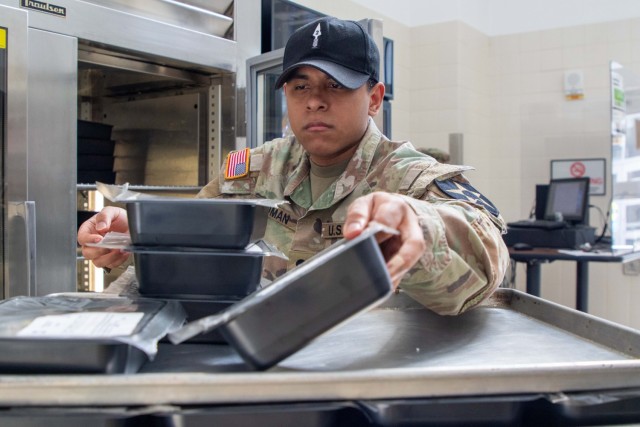
Spc Roman, a culinary specialist, at the Raptor Warrior Restaurant takes account of meal prep items for the day on Joint Base Lewis-McChord, Wash. on March 4, 2024. The meals served to the Soldiers who enter the Raptor Warrior Restaurant are dietician approved, nutritious, and healthy for Soldiers who want to maintain, gain, or lose weight. (U.S. Army photo by Spc. Karleshia Gater, I Corps Public Affairs)
VIEW ORIGINAL
VIEW ORIGINAL
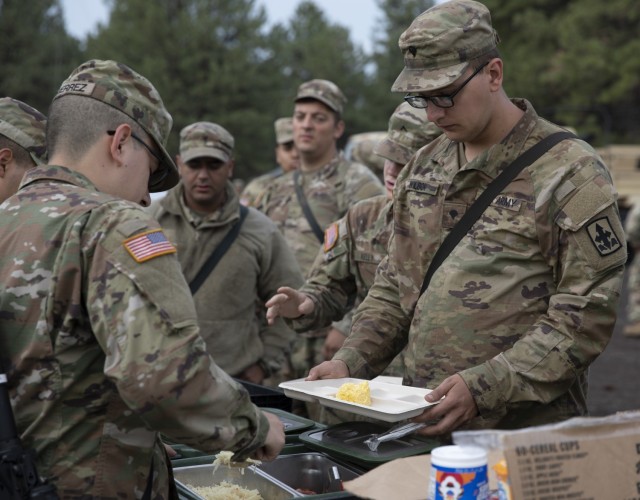
Soldiers of G-Co., 29th Brigade Support Battalion, Arizona National Guard, line-up to eat the breakfast prepared by their own award-winning 92Gs, Food Service Specialists, on Camp Navajo, Bellemont, Ariz., July 14.
The Food Service Specialists of G-Co., recently placed second in the Department of Defense Phillip A. Connelly Award Competition proving they are ready to stand with their Active-Duty counterparts anytime, and anywhere they are called.
(Photo by Army Staff Sgt. Nicholas Moyte)
VIEW ORIGINAL
Q1. What is the Army Food Program Board of Directors and what does it do?
A1. The Army Food Board of Directors oversees the Army’s focus areas to modernize food service operations – from field feeding, culinary training and installation food establishments to policies, regulations, and authorities to drive innovation and transformation.
The Army Chief of Staff has charged the Army Materiel Command with management and oversight of the Army Food Program, with the AMC CG heading a tri-chaired BOD that are responsible for the food program’s garrison operations (AMC), policy (HQDA G-4) and training (CASCOM). The BOD is geared toward modernizing and revolutionizing the AFP through four lines of effort: policy, programming, and standards; forward development, modernization, and institutional training; food service innovation and transformation; and the optimization of food service operations.
Q2. What did the Army use to develop its nutrition/dietary requirements?
A2. The Army worked with DoD nutritionist and lead agents in the DoD Nutrition Committee. The expectation is that the Army will meet and exceed nutritional/performance requirements in the White House Strategy on nutrition and hunger and all associated DoD policies. In addition, the Army’s nutrition guidelines meet the American College of Sports Medicine and the Harvard University School of Public Health/Department of Nutrition. We are aligned with the “Go for Green” principles and the “Menu of Change” program from the Culinary Institute of America and Harvard University. We will fully support the “military dietary references intakes” found in AR 40-25, “Nutritional Standards for Performance Enhanced Nutrition.”
Q3. With all this “top-level” shaping, will Installation/Senior Commanders be able to influence food service changes?
A3. Yes. Food modernization relies on installation leaders to inform, advise, synchronize, and execute indicatives. Every installation is unique. A modernized Army Food Program will offer Senior Commanders maximum flexibility to leverage a wide variety of options to best feed their Soldiers.
Q4. Is the Performances Meal Prep Program available at all installations?
A4. Meal prep was established at 17 installations (tailored take-out meals). Meal prep is a favorable choice for barracks Soldiers since they can pick up multiple meals during a single visit to the dining facility and consume them later.
Q5. What is the timeline for when the food modernization is to be completed?
A5. The Army Food Program will undergo continuous modernization to best support Solider where they are. While we expect some quick-win initiatives, such as the expansion of food options including kiosks, food trucks and Meal Prep Programs, other revolutionary changes, like the Campus Style Dining Venue, the Army will make regular assessments, consider lessons learned, and adjust accordingly as we roll out additional locations.
Q6. What is the purpose of the Army Basic Allowance for Subsistence (BAS)?
A6. Basic Allowance for Subsistence (BAS) is a cash allowance to Soldiers to defray a portion of their food expenses. By law the Department of Defense policy requires BAS deductions for three meals a day. Soldier can request reimbursement for missed meals in some instances, using DD Form 1475. Army Regulation 637-1 requires commanders put Soldiers in the barracks on a meal card system if the installation has a DFAC (with a few exceptions). The meal card system requires BAS deductions by the Defense Finance and Accounting Service (DFAS).
Q7. What does the Army Food Program (AR 30-22) govern?
A7. The AR 30-22 regulation governs the operation of Army dining facilities, ensuring service members receive nutritious meals that support their health and performance.
Q8. What is Essential Station Messing (ESM)?
A8. Essential Station Messing (ESM) is a program that provides three meals to enlisted service members living in barracks. It is messing declared by the installation, base, or station commander responsible for single government quarters, and is essential for the health and safety of enlisted personnel permanently assigned to single quarters.
Q9. What are the Army’s nutrition and meal standards?
A9. The Army follows strict nutrition guidelines to ensure service members receive balanced meals that support their health and performance. These guidelines are outlined in Army Regulation 40-25, which establishes policies for optimizing Solider health through proper nutrition.
Q10. What is Nutritional Readiness?
A10. Nutritional Readiness is the ability to recognize, select and consume the required food and drink to meet the physical and non-physical demands of any duty or combat position, accomplish the mission, and come home healthy.
link