Investigation of the effects of phytogenic dietary additives on growth performance, nutrient utilization, economic efficiency and health of Pangasius hypophthalmus : implications for sustainable aquaculture development
The health of fish is significantly affected by physicochemical characteristics, which are essential for their well-being37. In closed aquaculture systems, overfeeding leads to increased waste, degrading water quality by producing ammonia and depleting oxygen43. Consequently, inadequate water quality conditions reduce feed intake, increase the feed conversion ratio (FCR), and lower survival rates44,45. Quality parameters such as temperature, salinity, dissolved oxygen (DO), pH, ammonia, alkalinity, and nitrate varied somewhat among treatments. Still, they remained within the suitable range for P. hypophthalmus cultivation, as shown in Table 2. Although P. hypophthalmus has a broad temperature tolerance range (20–38 °C), the species grows most optimally between 24 and 34 °C46. Additionally, P. hypophthalmus prefers an ammonia level between 0.002 and 0.06 mg/L. Fish mortality increases when ammonia levels rise from 0.24 to 0.50 mg/L47. According to Kucuk3, the water quality results in this investigation generally support the growth of P. hypophthalmus. The study revealed that P. hypophthalmus could grow and survive within these parameters4.
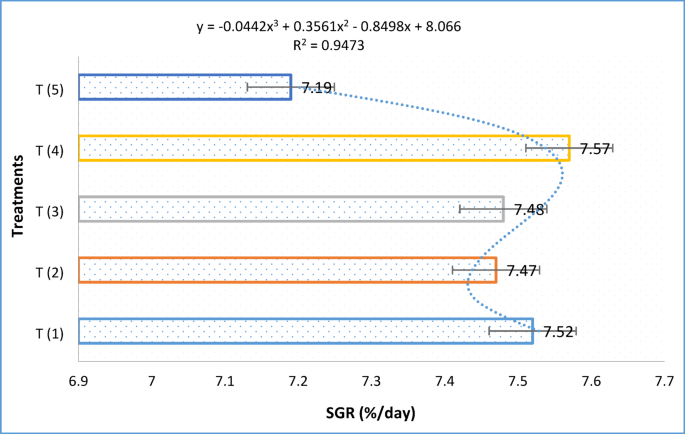
After a 70-day feeding study, P. hypophthalmus fed diets supplemented with turmeric, garlic, aloe vera, and combined supplementation showed increased growth in comparison to the control diet. Conversely, fish fed a diet devoid of supplements had much worse growth and survival rates. Turmeric has been demonstrated to have a positive effect on growth performance in P. hypophthalmus6, African catfish (Clarias gariepinus)48 common carp (Cyprinus carpio)49 and rohu (Labeo rohita)23 When compared to the control diet, P. hypophthalmus that received feed supplements including turmeric also displayed enhanced growth and feed functionality, FCR, and intake50.
To the best of our knowledge, this is the first study to discuss including medicinal herbs in a fish diet. According to the current investigation, blended supplements may be a valuable herb for fostering P. hypophthalmus development51. Osphronemus goramy body weight rose when T1 and Mixed (T4) supplements were added to their food52.
Garlic, a medicinal plant with immunostimulant effects, contains growth promoters, antioxidants, and antimicrobials25 and ensures improved feed digestibility27. Research has shown garlic’s impact on P. hypophthalmus growth, survival, feed use, and proximate composition26, with various species experiencing growth, survival, and biological performance improvements53.
Among the herbs examined, the one used in this study (T2) was the least effective in promoting growth. Numerous research has shown that adding herbs to the P. hypophthalmus diet can improve feed performance and development54,55. When ginger (Zingiber officinale) and nutritional onions (Allium cepa) were added to tiger grouper (E. fuscoguttatus) formula feed, the fish showed noticeably improved SGR, feed efficiency, and survival rates as compared to the control group54.
In a similar vein, feeding orange-spotted grouper (E. coioides) garlic (Allium sativa) significantly enhanced the fish’s feed efficiency, development rate, and resistance to infection by Streptococcus iniae55. In a related study, after being fed katuk (Sauropus androgynus), orange-spotted grouper displayed a significant increase in weight gain and SGR56. These results suggest that grouper diets supplemented with the right kind of herbs may benefit from enhanced fish development and performance.
All of the treatment groups in the current study were in favor of adding herbs to the prepared menus. T2 and T3 had feed conversions that were much greater than T4 and comparable to T5, respectively. Nonetheless, the fish’s development was unaffected by the lack of supplementation. According to Huq4, the feed efficiency of T1 and T5 showed a significant overall improvement in terms of growth performance, PER, and FCR.
The P. hypophthalmus that were fed T4 meals exhibited the highest GP and the lowest feed consumption of all the treatments. This indicates that P. hypophthalmus development was stimulated by dietary supplementation with (T1) and (T4), without increasing feed intake, by boosting the efficiency of protein retention.
Additionally, the body protein content of T4 was marginally greater than that of T5, which further corroborated the P. hypophthalmus strong protein retention and efficacy. Previous studies on Japanese flounder57 and Pangasius hypophthalmus58 demonstrated that increased protein and protein retention efficiencies promote fish development.
According to the previous studies52,54,56 effects of medicinal plant extracts can vary significantly among different fish species. Excessive or poorly balanced supplementation can lead to toxicity, reduced palatability, or stress, especially if bioactive compounds are not dosed correctly. Additionally, uneaten feed or fish waste containing plant residues may negatively impact water quality or disrupt the microbial balance in the system if not properly monitored these findings were consistent with the previous observations56,57,59.
The use of medicinal plant extracts presents a promising strategy for promoting sustainable aquaculture, but it is essential to consider species-specific responses and potential environmental interactions.
This research offers a more comprehensive evaluation by assessing growth performance, nutrient utilization, health status, and economic efficiency specifically in Pangasius hypophthalmus. These findings support the broader application of plant-based feed additives as effective and eco-friendly alternatives to synthetic compounds in aquaculture systems2,3,19.
Furthermore, higher consumption of protein, gain, and retention all markedly accelerated the development rate of Nile tilapia59. Also, among the therapies, (T4) likewise had the best survival rate. This suggests that T1 and T4 are prospective herbs to enhance P. hypophthalmus growth, survival, and feed efficiency3.
Also, T1 and T5 had considerably greater CP, fat, and dry matter than T5. This showed that while the feed efficiency of P. hypophthalmus given mixed (T4) and turmeric (T1) was comparable to that of the standard diet, the addition of these herbs improved the digestion and absorption of nutrients. This finding is in line with a report on P. hypophthalmus in which the supplement of turmeric to the diet upgraded and altered the gut flora, leading to better growth, increased microbial enzymatic activity, increased numbers of beneficial bacteria, and increased nutritional digestibility50. Turmeric has also been reported to be a helpful digestive stimulant that promotes the activity of enzymes like lipase, chymotrypsin, and amylase60. It has been noted that incorporating herbs into peppermint (Mentha piperita) meal may enhance feed utilization and growth rate for fish species such as Caspian white fish (Rutilus frisii kutum) and Asian sea bass (Lates calcarifer)61.
This study assessed the physical status of P. hypophthalmus using the CF, HSI, and VSI. The fish fed (T1) and T4 had the highest HSI, but overall, there was no appreciable variation in HSI between the groups and control diets. Between the three therapies, there were no appreciable differences in the VSI or CF. the results pertaining to HSI support those reported by62.
There were no appreciable variations in HSI values between the treatment and control groups as a result of using medicinal plants. Furthermore, the present study demonstrated no discernible variation in the whole-body proximate composition between the fish-fed turmeric (T1) and T4), T2, T2, and the control group.
According to Patel6, P. hypophthalmus administered turmeric (T1) and mixed (T4) may have high body protein and fat levels in their carcass composition due to good growth and feed performance, body indices, and CP. Turmeric, a medicinal plant, is used as a coloring agent and spice. Its main ingredients are curcuminoids19, which have anti-inflammatory, antibacterial, and neuroprotective properties63. Because it increases growth survivability and feed conversion in a variety of fish species, turmeric’s growth-promoting qualities make it suitable and fit for aquaculture13,20.
Aloe vera, a tropical plant, has pharmacological activities like antiviral, antibacterial, and wound-healing effects29. However, its immunological effects on warm-blooded animals and its anti-toxicity and immunogenicity are not well understood30. Studies on Aloe vera extracts in aquaculture suggest that their benefits may be amplified when combined with other herbs or natural products (For example, thyme has been shown to enhance fish health and resistance8.
The fast growth of fish aquaculture has led to numerous diseases, causing economic losses, and traditional antibiotics and chemicals are now banned due to drug residues, pathogen resistance, and environmental pollution, which have been investigated by Adelmann33. Medicinal plants have become promising supplements due to their effectiveness and safety for sustainable aquaculture. Herbal extracts have been extensively studied for their efficacy in fish bacterial, fungal, parasitic, and viral diseases36. According to Aly35, black cumin oil and powder have antibacterial qualities against A. hydrophila, making them a promising herbal remedy for a number of conditions, such as inflammation, diabetes, hypertension, and asthma. They also help fish species’ blood hemoglobin, hematocrit, and globulin levels35.
The inclusion of plant-based feed additives in fish diets significantly affects fish health, growth, and economic efficiency through several key mechanisms. Bioactive compounds found in these plants, such as flavonoids, alkaloids, and essential oils, stimulate digestive enzymes, leading to improved nutrient absorption and a better feed conversion ratio (FCR). This results in enhanced growth performance and more efficient feed utilization complement the findings3,27,50 the medicinal plant enhanced the blood parameters. Phytotherapy has emerged as a promising alternative to antibiotics for treating bacterial infections in P. hypophthalmus. It utilizes the antimicrobial, immunostimulatory, and anti-inflammatory properties of various medicinal plants. Compounds such as allicin found in garlic (Allium sativum), curcumin from turmeric (Curcuma longa), and aloe vera (Aloe vera) demonstrate strong antibacterial effects, particularly against pathogens like A. hydrophila, which is a common cause of infection in Pangasius .The hematological parameters in the current research demonstrated significant alternation between the fish in the control group and other groups, which seems to be consistent with the results of our study6,12,30.
Phytotherapy has gained recognition as an effective treatment method36. An experiment using extracts from aloe vera, garlic, and turmeric was conducted to treat diseased fish, resulting in the recovery from bacterial infection64,65,66. Medicinal plant are commonly employed to treat illnesses and prevent diseases in humans and animals67,68. Due to their excellent therapeutic efficacy, low toxicity, minimal side effects, diverse drug targets, and reduced likelihood of developing drug resistance, they have been extensively utilized in fish aquaculture in recent decades. They have emerged as a preferred therapy to replace antibiotics and chemicals33,69.
link